Exploring Ai2’s Open Language Models: OLMo 2
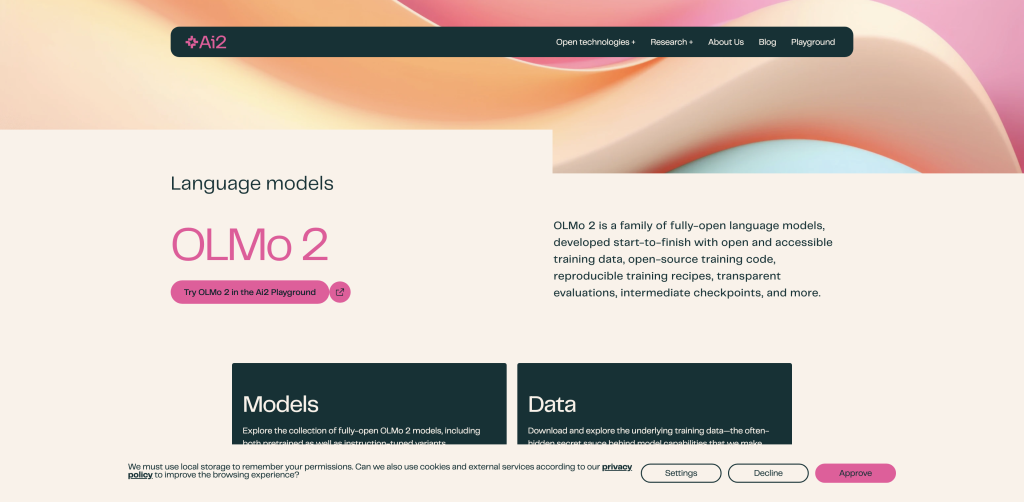
Ai2, a leading research organization in the field of artificial intelligence, has introduced OLMo 2, a family of fully-open language models that have been developed with a strong emphasis on openness and accessibility. These models are equipped with open and accessible training data, open-source training code, reproducible training recipes, transparent evaluations, intermediate checkpoints, and more.
The OLMo 2 model family includes a collection of fully-open models, ranging from pretrained to instruction-tuned variants. Users can also download and explore the underlying training data that has been made freely available to support open scientific research. The high-performance training code for OLMo 2 can be used and extended for language model training and experimentation.
One of the key aspects of OLMo 2 is its commitment to transparency and sharing of resources. Ai2 openly shares its data, recipes, and findings, with the aim of providing the open-source community with the necessary tools to innovate and enhance model pretraining techniques. By offering insights into the ideas of mid-training, data curriculum, and the relationship between training stability and performance, Ai2 hopes to inspire new approaches in the field of language model development.
The Philosophy Behind OLMo 2
Early work on pretraining language models focused primarily on a single stage of pretraining using massive amounts of unstructured text. However, as the field has evolved, more sophisticated approaches such as mid-training and data curriculum have emerged. Despite the success of these techniques, many existing models provide limited information on their implementation.
With OLMo 2, Ai2 aims to bridge this gap by openly sharing its data, training code, and evaluation results. This approach not only fosters collaboration within the research community but also encourages innovation and experimentation in the development of language models. By providing the necessary resources and insights, Ai2 hopes to empower researchers to explore new avenues in model pretraining and improve overall performance.